
Validated desktop statisticsSigma
Sigma
Statistics
Run guided statistical analyses from descriptive summaries to survival and competing risks — without coding or uploading sensitive research data.
One-time purchase · No monthly subscription
11 documented modulesFull-precision validationLocal processingDOCX + XLSX
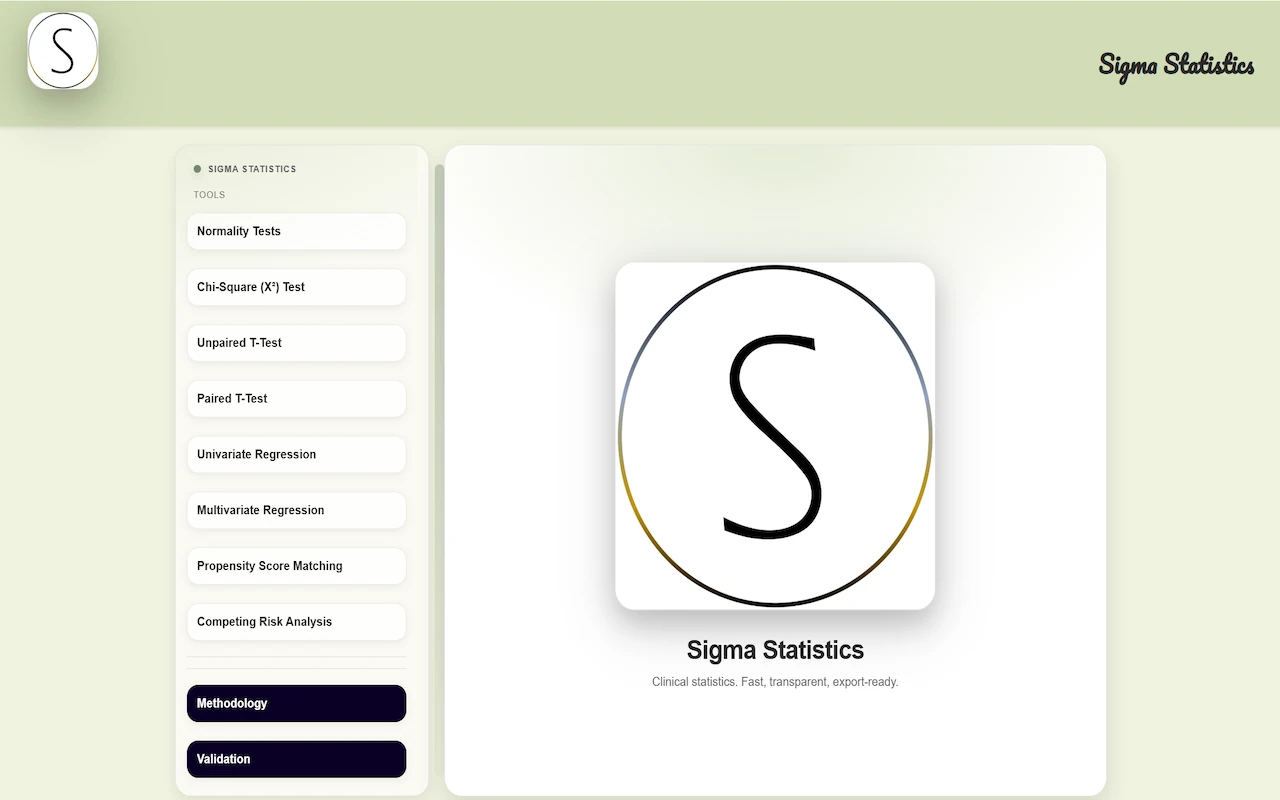
Statistical tools
Focused methods.
Transparent outputs.
Eleven structured workflows cover routine summaries, inference, regression, matching, time-to-event analysis and competing risks.
Independent reference workflows
Validation reported at full precision.
Production calculation cores were compared against independently implemented R workflows using deterministic datasets, targeted edge cases and module-specific acceptance criteria.
256,822 / 256,822descriptive-statistics comparisons passed
104,770 / 104,770ANOVA comparisons passed
3,833,940 / 3,833,940survival-analysis comparisons passed
1,080 / 1,080PSM runs with exact pair identity
2,089,198paired cumulative-incidence time points
Sigma distinguishes stable results from malformed, degenerate, separated, singular and otherwise non-estimable cases instead of silently presenting unreliable inference.
Review the complete validation compendium →Data sovereignty
Your data never needs to leave your computer.
Sigma is a standalone desktop application. CSV data is imported and analyzed locally; sensitive clinical or scientific datasets are not uploaded to a GBM Consulting calculation server.
Defined preprocessing rules, full-precision calculation cores, explicit warnings and exportable results support traceable research documentation. Users remain responsible for study design, method selection, assumptions and scientific interpretation.
Read the complete methodology →Scientific transparency
Methods you can inspect.
Results you can verify.
Start analyzing with Sigma.
One purchase for your offline macOS or Windows workflow.
One-time purchase · No monthly subscription